

Your dental implant is done, your mouth is still numb, and dinner has become a real problem. You’ve fasted for hours before surgery, so you’re hungry, and nobody covered this properly at discharge.
Here’s the short version. Cool liquids on day one. Soft food that needs almost no chewing for the first week. Nothing hot, and no straws.
What you eat in that first week protects the clot, and the clot protects the bone healing around the implant. That’s the whole reason the rules exist.
At Credence Dental, our prosthodontist and implantologist plans every dental implant in RR Nagar alongside the aftercare that follows, because a well placed implant still depends on a careful first month. Below is what you can eat after dental implant surgery: a full guide.
What Can You Eat Right After Dental Implant Surgery?
Cool liquids only, for the first 24 hours. Heat increases bleeding and swelling, so let everything cool to room temperature before it goes near your mouth.
Day one works well with:
- Buttermilk, thin and unspiced
- Plain curd, loosened with a little water
- Cooled dal water or thin rasam, without tempering
- Tender coconut water, poured into a glass
- Cold milk or badam milk
- Cooled ragi ganji, thin enough to sip
Skip the straw completely. Sucking creates negative pressure in your mouth, and that pull can disturb the clot protecting the surgical site. Drink straight from the glass, tilting away from the implant side.
How Long Do You Need To Eat Soft Food?
Initial recovery usually takes a few days to a week. Bone integration takes several months, but your diet does not stay locked down for that whole period.
| Stage | What you can eat |
|---|---|
| First 24 hours | Cool liquids only, no chewing at all |
| Days 2 to 7 | Soft food needing little or no chewing |
| Weeks 2 to 6 | Soft solids, chewing on the opposite side |
| After the crown | Normal food, reintroduced gradually |
Two things stretch this timeline. If our implantologist placed a bone graft alongside the implant, or if you had several implants in one sitting, expect the soft phase to run longer. Your dentist will tell you which applies to you at the follow up.
Which Foods Are Safe In The First Week?
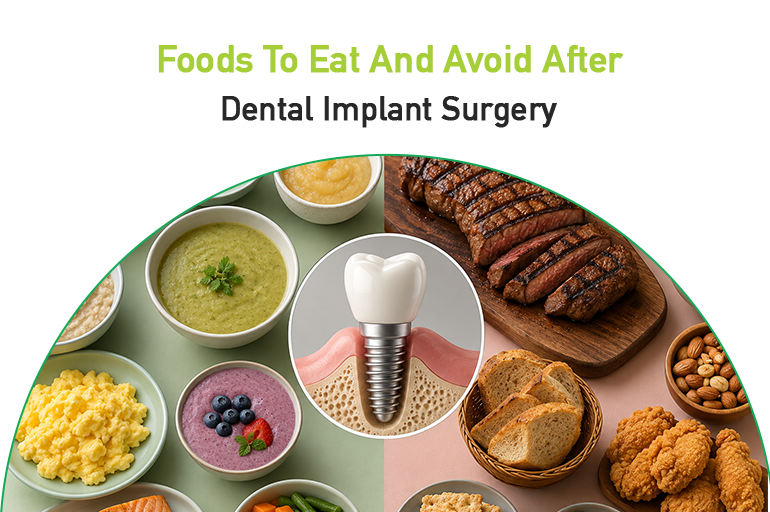
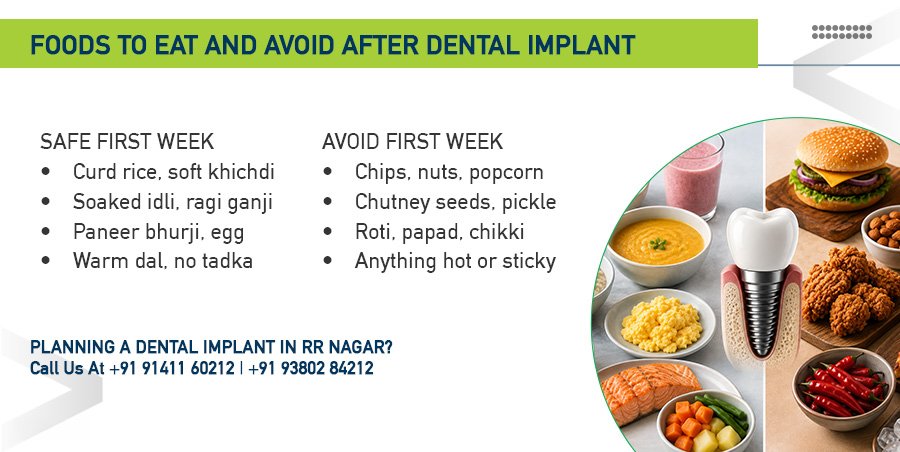
Soft, warm, and unspiced. You need protein for healing, so build meals around that rather than living on juice for a week.
Safe through days two to seven:
- Curd rice, mashed soft with no crunchy tempering
- Plain khichdi, cooked past the point of firmness
- Idli soaked in milk or thin sambar until it falls apart
- Ragi ganji, oats porridge, or semiya kheer
- Paneer bhurji or scrambled egg
- Dal without tadka, or thin sambar without seeds
- Bottle gourd, pumpkin, or carrot cooked until soft
- Mashed banana, chikoo, or stewed apple
Watch the temperature. Warm is fine from day two, hot is not. Let filter coffee, chai, and rasam sit until they stop steaming. Numbness from the anaesthetic can also hide a burn, so be careful on the first day especially.
Which Foods Should You Avoid After Implant Surgery?
Anything hard, sharp, sticky, seedy, or hot. Each one carries a specific reason, and the reasons matter more than the list.
- Chips, nuts, and popcorn, because fragments lodge in the healing site
- Coconut chutney with mustard seeds or sesame, for the same reason
- Pickle, spicy sambar, and heavy chilli, which irritate an open wound
- Crusty bread, roti, and papad, which need real force to break
- Sticky sweets, chikki, and chewing gum, which pull at the site
- Noodles and stringy pasta, which wrap around stitches
- Corn on the cob and sugarcane, which demand front tooth biting
- Hot filter coffee, hot chai, and hot rasam
- Alcohol during the first few days, especially alongside prescribed medicines
Seeds are the quiet problem here. One mustard or sesame seed lodged in the site can set off irritation that takes days to settle.
Why Should You Avoid Straws, Smoking, And Paan?
All three disturb a site that needs to be left completely alone. They do it in different ways, and smoking is the most serious of the three.
A straw creates suction. Smoking creates suction plus heat plus chemicals that slow healing and reduce blood supply to the bone. Smoking and vaping raise the risk of implant failure, which is why we ask patients to stop before surgery rather than after.
Paan, gutkha, and chewing tobacco add pressure and grit directly against the healing gum. In India this matters more than most aftercare sheets admit, since 28.1 percent of adults aged 15 and over use tobacco, per the WHO Oral Health Country Profile for India, 2022.
If you use any of these, tell your dentist. It changes how we plan your healing checks.
How Should You Chew, Rinse, And Clean While Healing?
Chew on the opposite side and leave the implant site alone. Most early problems come from touching the area, not from eating the wrong thing.
- Chew on the side away from the implant for two weeks
- Skip rinsing and spitting on day one, since both disturb the clot
- From day two, rinse gently with warm salt water if your dentist advised it
- Brush your other teeth normally with a soft brush
- Clean around the site, not directly on it, until your dentist clears you
- Don’t poke the area with your tongue, finger, or a toothpick
If food gets trapped near the site, let a gentle rinse shift it. Digging with anything sharp does more damage than the food would.
When Can You Eat Normally Again After A Dental Implant?
Gradually, and fully only after your dentist fits the crown. This is the part patients most often misunderstand.
An implant is a titanium post placed in the jawbone. It is not the finished tooth. The visible tooth, called the implant supported crown, goes on later, once the bone has fused around the post.
So chewing power returns in stages. Soft solids come back in weeks two to six, firmer food follows as comfort allows, and full chewing on that side waits for the crown. Our page on dental implant in RR Nagar walks through the whole sequence.
What Should You Do If Something Goes Wrong?
Don’t panic, and don’t wait it out. If you sipped through a straw once or ate rice too early, watch for symptoms rather than assuming the implant has failed.
Call us if you notice:
- Bleeding that hasn’t settled after a few hours of gentle pressure
- Swelling that increases after day three instead of easing
- Pain that climbs rather than fades
- A bad taste, or discharge from the site
- The implant or healing cap feeling loose
- Food packed near the site that rinsing won’t shift
That last one matters long term too, because food sitting against an implant inflames the gum around it. Good gum care protects an implant the same way it protects a natural tooth.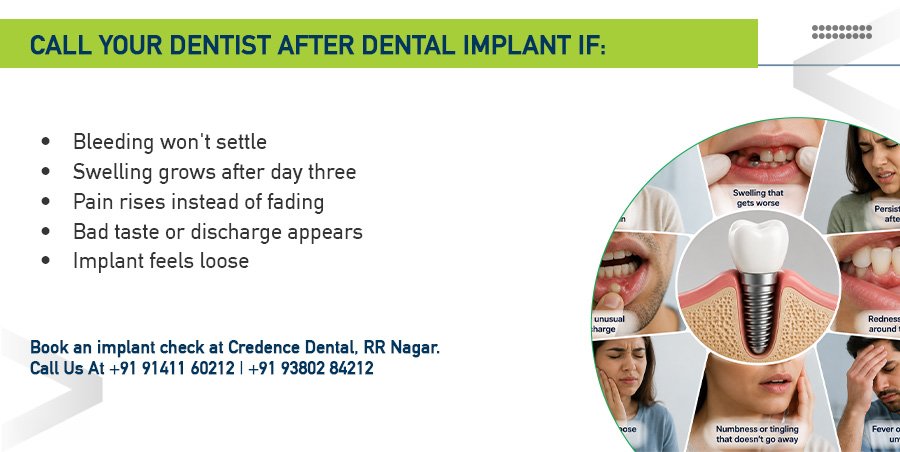
What Should You Do Next?
Eat softer than you think you need to for the first week. Most early implant problems we see trace back to one hard bite, not to slow healing.
Keep the protein up, keep the site clean, and keep the follow up appointment even if everything feels fine. You can’t judge healing under the gum from outside.
If you’re comparing options for the best dental implant clinic in RR Nagar, ask how they plan the healing checks, not only the surgery. The follow up decides how well the implant settles.
Book Your Implant Follow Up At Credence Dental
Aftercare is part of implant treatment, not an extra. If your healing doesn’t look right, or a sore spot won’t settle, our dentists in RR Nagar can check it in a short visit.
We bring 9+ expert dentists and 15+ years of experience to RR Nagar. Visit us at Credence Dental, BEML Layout 3rd Stage, RR Nagar, Bengaluru 560098, or call us on +91 91411 60212 or +91 93802 84212 to book your appointment. We’re open Monday to Saturday, 10:00 am to 8:30 pm.
Frequently Asked Questions
Can You Eat Rice After Dental Implant Surgery?
Yes, from day two, as long as it’s soft. Curd rice mashed well or rice cooked into khichdi works better than firm steamed rice. Loose grains can drift into the surgical site, so rinse gently afterwards.
Can You Drink Tea Or Coffee After A Dental Implant?
Not on day one, and never hot. Hot drinks make the first 24 hours bleed and swell more. From day two, let your chai or filter coffee cool to warm, and drink it from the cup rather than through a straw.
When Can You Start Chewing On The Implant Side?
Usually after your dentist confirms healing, and fully once the crown goes on. Give it at least two weeks of chewing on the other side. Rushing this is the most common reason patients come back sore.
Can You Eat Non Vegetarian Food After Implant Surgery?
Yes, if it’s soft and boneless. Shredded chicken, boneless fish, and egg work well from day two or three. Avoid bones, gristle, tandoori crust, and anything you’d normally tear with your front teeth.
Does A Bone Graft Change What You Can Eat?
Yes, it usually extends the soft food phase. A graft adds bone material to support the implant, and that site needs longer undisturbed. Follow the timeline your dentist gives you rather than the general one.
How Soon Should You See A Dentist Near Me After Implant Surgery?
We review most patients within a week, and again as healing progresses. If you’re searching for a dentist near me because bleeding, swelling, or pain is worsening, don’t wait for the scheduled visit. Call the clinic that placed the implant first, since they have your scans and surgical notes.