

Your X-ray shows a dark spot at the tip of a tooth root. Your dentist calls it a granuloma. Or you have a tooth that aches off and on, plus a pimple on the gum that keeps coming back. Either way, you want answers.
What is dental granuloma and how to cure it? Here’s the short version. A dental granuloma is a pocket of inflammed tissue at the tip of a tooth root. It forms when bacteria infect the nerve inside the tooth. Tablets and home remedies can’t clear it. A dentist treats the infection at its source, usually with a root canal.
At Credence Dental, a dental clinic in RR Nagar, our endodontists treat these infections. An endodontist is a root canal specialist. Our aim is simple: save your natural tooth whenever possible. We plan each case with digital X-rays, a 3D scan when needed, and microscopes. We explain your options before treatment starts. This guide from our experts covers the symptoms, causes, and treatment in plain words.
What Is Dental Granuloma and How to Cure It?
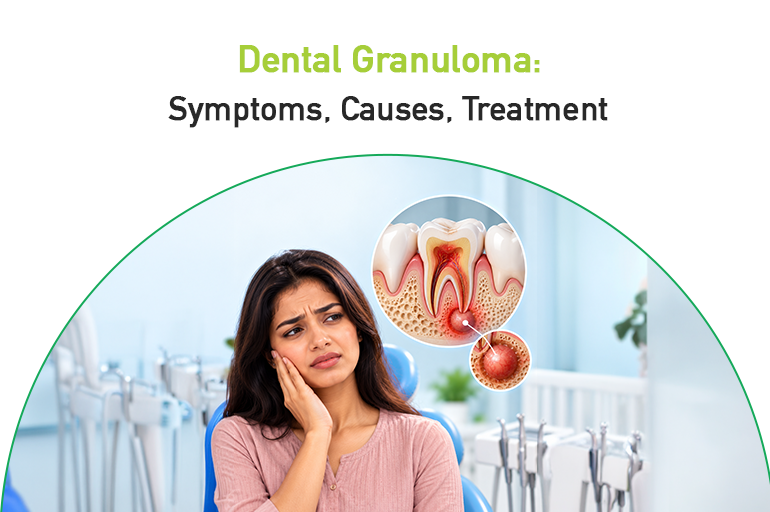
A dental granuloma is a small lump of inflamed tissue in the bone at the tip of a tooth root. Dentists also call it a periapical granuloma.
It starts with the pulp, the soft tissue inside your tooth that holds the nerves and blood vessels. When bacteria infect it, the pulp dies. Your body can’t reach bacteria inside a dead tooth, so it builds a wall of inflamed tissue around the root tip.
No tablet or home remedy removes it, because the bacteria live inside the tooth. Root canal treatment is the usual fix. It cleans and seals the inside of the tooth, which stops the infection and lets the bone heal. Some teeth need a repeat root canal, minor root tip surgery, or removal.
Dental Granuloma vs Pyogenic Granuloma
Don’t confuse it with a pyogenic granuloma. That one is a soft red lump on the gum. It bleeds easily and usually comes from irritation or injury. A dental granuloma sits inside the bone, out of sight, at the root tip. The two need different treatment.
What Are the Symptoms of Dental Granuloma?
Often, none. A granuloma can stay silent for months or even years. That’s why dentists usually spot it on an X-ray first. When it acts up, you may notice:
- Pain when you bite or chew
- A dull ache that’s worse at night
- Swelling or tenderness in the gum near the tooth
- A pimple on the gum that drains pus, then returns
- A deep cavity in the same tooth
Facial swelling or a fever needs a dentist the same day. Trouble breathing or swallowing needs an emergency room.
What Causes Dental Granuloma?
It starts when bacteria reach the pulp. They get in through:
- A deep cavity you left untreated
- A knock that damages the nerve
- A crack in the tooth
- An old root canal that leaked, missed a canal, or got reinfected
- A broken or leaking filling or crown
Untreated decay is the usual starting point. It’s also the easiest cause to prevent.
How Do Dentists Diagnose Dental Granuloma?
Your dentist asks about pain and swelling, taps the tooth, and checks the gum. Then a small dental X-ray shows the roots and the bone around them. On the X-ray, a granuloma looks like a dark, round area at the root tip. When the picture isn’t clear, a CBCT scan (a 3D dental scan) fills in the gaps.
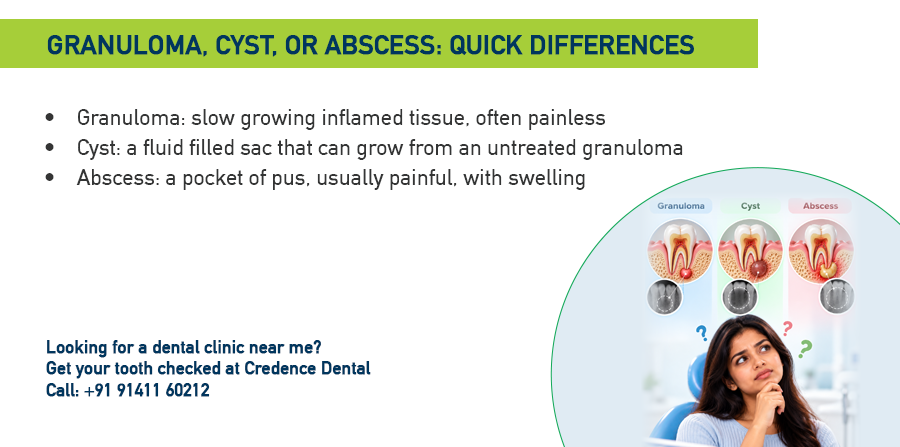
An X-ray has one limit. It can’t always tell a granuloma from a cyst, because both show as a dark spot. Your endodontist plans treatment from the whole picture: your symptoms, the tooth, and the scans. Only a lab test of removed tissue confirms which one it is.
How Is Dental Granuloma Treated?
The goal is to remove the infection and save the tooth if possible. The right treatment depends on how much healthy tooth remains. It also depends on whether the tooth has had a root canal before.
| Treatment | When It Fits |
|---|---|
| Root canal treatment | The tooth has enough healthy structure to save |
| Root canal retreatment | An old root canal leaks, a canal was missed, or the tooth got reinfected |
| Apicectomy (root tip surgery) | Infection persists after root canal treatment, and retreatment cannot clear it |
| Tooth removal | The tooth is too damaged to restore |
In a root canal, we numb the area with local anaesthesia. We open the tooth and remove the infected pulp. Then we clean the canals and seal them with gutta percha, a rubbery filling material. Our endodontists use digital X-rays, CBCT scans when needed, and microscopes. These help them see small canals clearly.
A tooth with a root canal is weaker. Back teeth and weak teeth usually need a crown. We aim to place it within 15 to 30 days when we advise one.
Do antibiotics help? Not on their own. They can calm a spreading infection. They don’t remove the infected tissue inside the tooth. So the problem returns when you stop them. Your dentist may prescribe them alongside treatment.
How Long Does Healing Take?
After a root canal, mild discomfort lasts a few days. Some teeth stay tender for a few weeks. Root tip surgery needs about 1 to 2 weeks for first healing, and the bone takes longer, so we check it with follow up X-rays.
Results depend on the tooth’s structure, how deep the infection runs, and how well we restore the tooth. After your exam, we explain what to expect.
What Happens If You Leave a Dental Granuloma Untreated?
It won’t clear up on its own. The bacteria stay inside the tooth. The granuloma can grow and destroy more bone. It can flare up as an abscess or turn into a cyst. Some people see the gum pimple drain and think the problem healed. It hasn’t. The infection is still there. In the end, you can lose the tooth.
How Can You Prevent Dental Granuloma?
- Fill cavities while they’re small
- See a dentist after any knock to a tooth, even if it looks fine
- Finish root canal treatment with a final filling or crown
- Get old fillings and crowns checked
- Keep up regular check-ups, because an X-ray can catch a granuloma before it hurts
When Should You See a Dentist?
Book a visit if a tooth keeps hurting, hurts when you chew, or has a pimple or swelling beside it. Don’t wait for the pain to stop. A granuloma can stay quiet while it grows. Searching for a dental clinic near me with a toothache? A short exam and an X-ray usually give a clear answer.
Looking for a Dentist in RR Nagar for a Tooth Infection?
Two endodontists lead root canal care at Credence Dental. Dr Mohammed Ashrafulla holds a BDS and an MDS in Conservative Dentistry and Endodontics. Dr Sainath Adsare is an Endodontist with a BDS, an MDS, and over 15 years of experience with complex cases and repeat root canals.
People searching for the best dentist in RR Nagar for a root canal want a specialist and a clear plan. You get both here. You get an exam, a digital X-ray, a CBCT scan when needed, and a plain explanation of your options before we start.
We’re at No 1132, 1st Floor, Jawaharlal Nehru Rd, BEML Layout 3rd Stage, RR Nagar, Bengaluru 560098. It’s easy to reach us from Rajarajeshwari Nagar, Kengeri, and Banashankari. We offer free parking and lift access.
Book Your Tooth Check at Credence Dental
If a tooth keeps hurting, or an X-ray showed a dark spot at a root, book an exam. Still asking what is dental granuloma and how to cure it for your own tooth? The exam gives you the answer. We’ll find the cause and tell you what saves the tooth.
Call us at +91 91411 60212 or +91 93802 84212, or write to contact@credencedental.com. We’re open Monday to Saturday, 10:00 am to 8:30 pm, and closed on Sundays.
This content is for patient education only. A dentist must check your teeth, gums, and X-ray findings in person before confirming diagnosis or treatment.
Frequently Asked Questions
Can a dental granuloma go away on its own?
No. The bacteria stay inside the tooth. The granuloma keeps growing or stays put until a dentist treats the source.
Is a dental granuloma painful or dangerous?
It often causes no pain. That’s part of the risk, because it grows quietly. If it flares into an abscess, you get pain and swelling. Early treatment prevents that.
Can antibiotics or home remedies cure a dental granuloma?
No. Antibiotics can calm a spreading infection. They don’t remove the infected tissue inside the tooth. Home remedies can’t reach it. A root canal or other dental treatment does the real work.
Will I lose my tooth?
Not always. Root canal treatment saves many teeth with a granuloma. It works best when enough healthy tooth remains and the tooth gets a proper filling or crown. If the tooth is too damaged, your dentist explains the options.
How long does treatment take?
A simple root canal may need fewer visits. Teeth with several canals, old root canals, or heavy infection can need more. Your endodontist gives you a realistic plan after the exam.
Can a dental granuloma come back after a root canal?
It can, if the tooth reinfects. A leaking filling, a crack, or a missed canal can cause that. A repeat root canal gives the tooth another chance. Follow up X-rays show whether the bone is healing.
How do I choose the best dentist in RR Nagar for a root canal?
Choose a dentist with an endodontist on the team. Look for X-rays or a CBCT scan to plan treatment. Ask for a clear explanation of your options and costs before you start.
How do I find a dental clinic near me that treats tooth infections?
Search for a clinic with a root canal specialist and digital X-rays. Then read its patient reviews. Ours is in RR Nagar, with parking and lift access.